
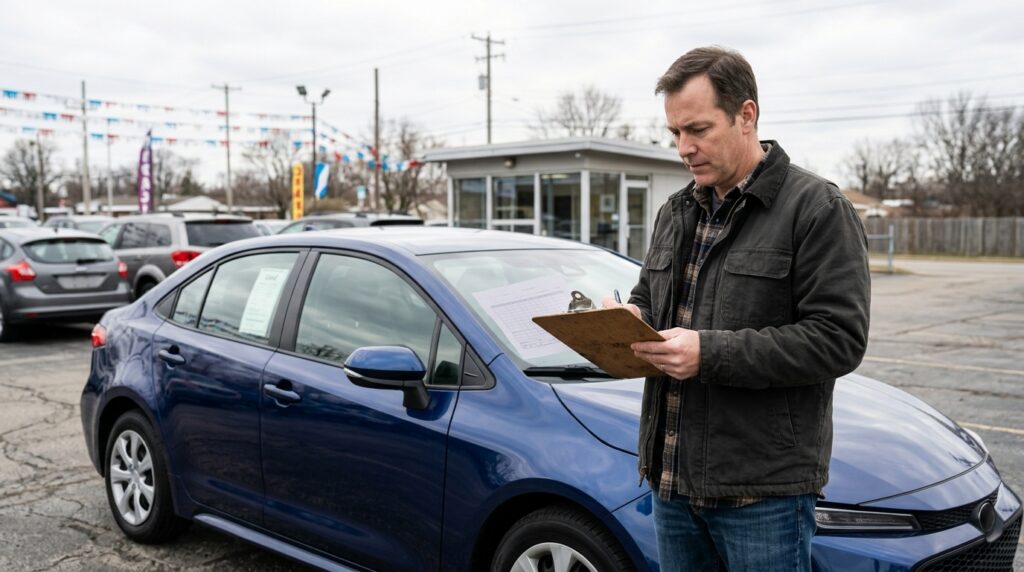
Used car dealer fees 2026 shoppers encounter can change a seemingly affordable listing into a much more expensive purchase. A car advertised at one price might be accompanied by a required document charge, preparation package, or confusing discount condition at the dealership. Those surprises make it hard to compare vehicles fairly.
In September 2026, the Federal Trade Commission (FTC) published new automobile pricing transparency FAQs. The guidance explains how existing federal prohibitions on misleading advertising apply to advertised prices, mandatory dealer fees, optional add-ons, and online vehicle listings. It is an important clarification, not a newly created nationwide tax, fee cap, or cancellation right.
For U.S. used-car buyers, the practical lesson is straightforward: get the price that any ordinary buyer can actually pay, compare the complete purchase cost, and inspect the contract before agreeing. Here is how to do that without losing sight of vehicle condition or financing.
What the FTC’s 2026 Pricing Guidance Says About Used-Car Advertisements
The FTC’s September guidance says an advertised car price must reflect the actual price an ordinary customer can pay, with only government-required consumer charges excluded. The agency emphasizes that dealer-required amounts belong in the advertised price instead of emerging after someone has already traveled to the lot.
The guidance applies to website listings, dealer advertisements, and other communications. Actual legality depends on the full advertisement and circumstances. State laws may impose additional disclosure requirements or limits, so shoppers should read local rules as well as federal guidance.
Mandatory Dealer Fees Versus Government-Required Charges

A useful starting point is to separate three categories: the car’s advertised selling price, dealer-required charges, and government-required taxes or registration amounts. The first two generally belong together when a dealer advertises a price, according to the FTC’s staff interpretation. Government-required charges paid by consumers may be excluded from the advertised figure.
Imagine a used sedan listed at $18,900. If the dealership requires every buyer to purchase a $695 preparation package, the FTC’s published interpretation says that mandatory dealership charge must be included in the amount advertised. A state-required sales tax is a different category. The actual out-the-door total can therefore still exceed a truthful advertised vehicle price.
Document, Reconditioning, and Preparation Fees
Labels do not determine whether a fee is optional. A document-processing charge, inspection package, or dealership preparation fee can be mandatory if buying that vehicle requires paying it. Under the FTC’s September explanation, a dealer cannot make an unavoidable charge disappear simply by placing it on a separate line later.
When reviewing a quote, ask which fees are required by government and which are set by the dealer. A dealer can have legitimate operating expenses, but you still need a clear, comparable price. Local rules may separately regulate how particular charges appear on documents. The FTC’s explanation does not eliminate those state-specific requirements.
Conditional Rebates and Dealer-Financing Discounts
A discount available only to military members, recent graduates, or customers using a particular lender should not make the general advertised price appear lower than ordinary buyers can obtain. The FTC discusses conditional pricing and says the amount available to any consumer must be most prominent.
Ask whether the offer requires a specific financing product, trade-in, loyalty status, or other qualification. Compare the vehicle’s cash price and financed price separately. A loan with an unfavorable APR can erase a small advertised discount quickly. For recent financing context, see our Q3 2026 used-car financing analysis.
Online Listings, Add-ons, and Price Surprises
Shopping begins online for many buyers, so transparent numbers matter before anyone steps inside a showroom. The FTC says listing pages that display vehicle prices should put the actual price in the most prominent position. Dealers also should not present a sold vehicle as available merely to attract customers toward a more expensive alternative.
Photographs deserve attention too. A used car’s condition is unique, so a representative photo should not mislead someone into expecting the exact car being sold. Request the VIN, current mileage, and actual listing photos. If the seller will not confirm basic details, keep looking. Our title washing and VIN fraud guide explains how to verify vehicle history separately from the advertised deal.
Optional Extras Should Be a Real Choice
Paint protection, tire-and-wheel plans, VIN etching, GAP coverage, and service contracts may be offered as extras. The key question is whether the product is actually optional and worth its separate price. The FTC warns against presenting an optional item as required or charging for a product a customer did not agree to buy.
Ask to see a detailed add-on list with individual prices and terms. Some products may be useful for specific buyers, but their value depends on coverage, exclusions, deductibles, and cost. An extended service contract is not the same as a manufacturer’s warranty. Compare third-party options and read cancellation provisions before choosing anything.
Do not assume a low monthly payment means a free add-on. Financing extra products can increase both the principal and the interest paid. The FTC’s used-car dealership buying guide recommends obtaining written prices and checking for late-added charges.
How to Compare Out-the-Door Quotes Before Signing

The simplest protection is a repeatable buying process. First, choose several comparable cars by year, trim, mileage, condition, and service records. Then request written out-the-door totals from each seller. That total should show all dealership charges plus estimated applicable taxes and registration amounts for your location.
Make sure everyone is quoting the same thing. A dealer with a lower sticker price might have higher required charges. Another dealer may advertise a slightly higher vehicle price but offer a cleaner, more transparent transaction. Compare vehicle condition and total financing costs as well as the cash purchase total.
A Practical Checklist for the Price and the Vehicle
Before visiting, save screenshots of the advertisement, inventory page, and any financing terms. Request the VIN, mileage, availability, and a written itemized out-the-door quote. If you plan to finance, seek outside preapproval so you have a benchmark for APR, term, and borrowing limits.
At the dealership, ask for the FTC Buyers Guide. It explains whether the vehicle is offered with a dealer warranty or as-is, subject to the applicable state’s rules. Request service records and a vehicle history report. The FTC recommends a pre-purchase inspection by an independent mechanic, even when a seller describes a car as certified or inspected.
Ask the technician for a written assessment and estimated repairs. A car that needs tires, brakes, or major mechanical work may not be a bargain even when the sales quote is transparent. To understand how a softer used-car market affects negotiation, see our September 2026 used-car pricing update.
What If the Price Changes at the Signing Table?
If an unexpected fee appears, stop and ask for a revised itemized quote. Compare it with your saved advertisement and earlier written offer. Ask for unwanted optional products to be removed, and do not sign simply because you have already spent several hours at the dealership.
Review the purchase agreement, retail installment contract, APR, payment schedule, total finance charge, and any trade-in figures. The Consumer Financial Protection Bureau explains that loan term, APR, trade-in value, and optional add-ons can affect the total deal. Ask questions until every line makes sense.
Remember that federal law does not generally guarantee three days to cancel a dealership car purchase. Some states or sellers provide specific return protections, but do not count on those unless you have verified the rules and received the terms in writing.
If you believe an advertisement materially misrepresented the required price, keep copies of the listing, quotes, messages, and contract. The FTC identifies ReportFraud.ftc.gov as a place to report suspected deceptive practices. Your state attorney general or consumer-protection agency may also be relevant.
Bottom line: Used car dealer fees in 2026 are easier to evaluate when you distinguish dealer-required charges from government charges, demand written out-the-door quotes, and treat optional products as separate decisions. The FTC’s September explanation reinforces long-standing expectations for truthful advertised prices; it does not replace careful inspection, financing comparison, or local consumer laws.
Editorial note: This article provides general U.S. consumer information as of November 2026. It is not legal or financial advice, and state-specific requirements may vary.